Alas, no nibbles, at least, no inexpensive ones. Last night I decided to remove the star gear on the end of the shaft, by gently tapping down on the shaft with two splints of wood under the gear; not only did the gear slide off, but the housing separated easily while I was tapping! (The long bolts had been removed.)
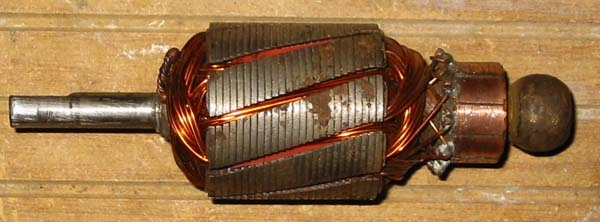
Apart from some inside rust, I can see that the brushes are in good shape; so’s the field magnets and the armature. I’m thinking I can fix this puppy myself! The oil-impregnated bearings have lost their lubricant, and are binding on the shaft; I’ll put some lightweight oil on these and keep them lubricated. And the commutator needs a good cleaning. But I bet it will run again!
The problem is further disassembly. The backing plate that holds the brushes appears to be pop-riveted to the bottom of the can. I’m thinking I’ll drill these out, remove the armature from the assembly to clean the commutator, and reassemble using small bolts.
What do you think? Anything I need to watch out for, would you do anything differently? Any advice greatly appreciated… I think I’ll take some pix as I go along.
Hmmm… Went to make indents in the rivet heads with a fine point punch – so I could drill them out – and they literally fell out! So the backing plate is free.
Still, I can’t pull the armature out of the can. It spins freely, but it’s almost as if there’s a retainer holding it in the bearing. I don’t wan’t to pull on it too much – does anyone have an idea about what could be holding it in place?
guessing: maybe a spring clip, though the purpose of that escapes me.
I wish I had some free time…I’d take apart one of my spare motors and play along with you..
Tom’s suggestion was a good one. I drilled a small hole in the recess that holds the bushing, and dripped in some rust cutter, a couple of times. Then I took a punch, braced the housing, and tapped the armature out…
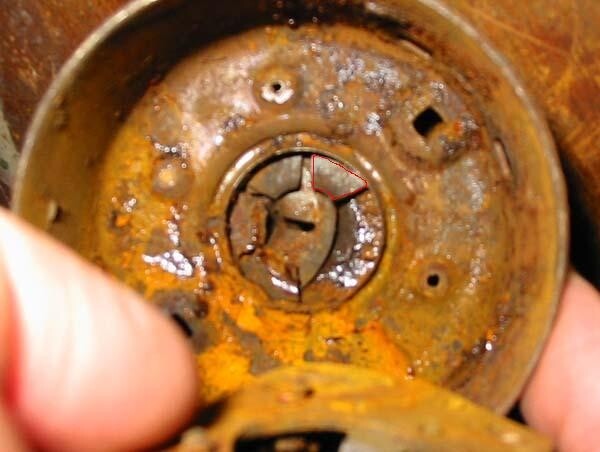
Tom was right; there’s no retainer for the shaft. But, there is for the bushing – and with the bushing frozen to the shaft, the retainer took the hit.
You can see where I outlined one of the 6 tabs in red, that comprise the retainer for the bushing. In the center is the fragment of retainer containing 2 tabs. Now, here’s what I propose to do, tell me what you think:
Clamp the bronze bushing between wood blocks in a vise, and after liberal doses of penetrating oil – again – attempt to tap out the shaft. (You’ll note that the commutators cleaned up nicely.)
Remove the fragment from the can, clean it all up, place the bushing in the center, and pot the bushing in the recess with high-temp RTV.
I’m thinking that will keep the bushing in place, and handle the heat well. (There are circuit breakers in these motors, BTW.) What do you think about this idea?
excellent pictures and description of a rusty motor.
First you gotta get the bushing/bearing off the shaft. The woodblock clamp seems like a good idea. Be patient w/ the rustcutter!!
As for setting the B/B back in the unit with RTV, I have little exp with RTV other than BlueRTV, which I don’t recall getting hard…maye the flexiblility will work to yur advantage. I wouldnt worry about heat…how many times do you need to crank up your windows?
Recently I used some epoxy putty on a project, which gets rock-hard, but then if you were just a teeny bit off, you would essentially ruin the whole thing.
Give it a try, Dan, if it fails, all you need is the base from another motor.
I am still fiddling with master p/w switch…the wires are so stiff, they essentially pull the terminal blocks off the switch contacts. So many times in and out of the door, now I’ve managed to break two of the snapclips, so the whole thing is held together with zipties and hangs from the door opening. I am headed to a WPC picnic, where I will adopt a forlorn look…maybe someone will take pity on me and offer me some parts/service/ another switch.
Roger
Hi Dan, I believe the retainer is there for assembly purposes, so it doesn’t fall out, If you get the bushing off the shaft and free to turn, I would assemble the motor and not worry about the retainer. Once it’s together, the bushing can’t go anywhere. Sealing it with something may not allow it to self align. No retainment will make it easy to take apart again, in case it doesn’t run the first time…
Tom
So Tom, you think that once the assembly is back together, the bushing won’t drift? I guess I could test that – assemble, and try to wiggle the shaft. My concern was that the armature might come in contact with the field magnets if it drifted at all. I’ll give it a try, and see how it goes.
Seems like there was a socket that the bushing would sit in, on motors I have had apart, and the retainer just held the bushing in the socket. Could be your motor is a little different. Hard to tell from your photo. If you don’t have the socket, then maybe you would need to use some form of material to build a socket to hold the bushing in the center.
Tom
I am sure now that you are right, Tom. I’ve removed the retainer fragments, and it’s clear that there’s a well for the bushing to sit in; when assembled, there’s no reason for it to shift. And now, I have a convenient hole for routine oiling
Meanwhile, the bushing is soaking in penetrating oil. A first attempt at a light nudge didn’t budge it, but Roger’s right: Patience is the word here. A little more oil every day, and some vibration to work it in, before I bring out the big guns.
As far as putting the backing plate back in position: I’m thinking of picking up some thin cotters. I don’t think they make pop-rivets that small; what would be ideal would be a plastic pin of some sort that I could cut and weld on the outside of the can, but I can’t think of where I might get those. The hole is about 3/32" wide, I’d guess – a little shy of 1/8". Any thoughts?
This topic is really handy for me. Maybe we need to do this too. How do you lower a rear window when it isn’t going down with the p/w switch??
Another question. Our driverside rear window isn’t going down with the switch there. It is going down with the switch where the driver sits (the master switch). What can this be???
(sigh) If it’s the motor, Matthew, the only way I know is to remove the panel and turn the drive shaft by hand. If the motor is frozen, as in my case, you will first have to remove the motor. But then, you will need to do that anyway to repair it! But first check to see that you have power at the switch – check with a VOM from the switch to ground. If you’ve got power, jump the wires to the switch with another wire. If that doesn’t work – sounds like the motor.
This sounds like the switch is bad – confirm by the check above. Good luck!
I’ve got power on the wires for sure. I don’t have to try to change wires cause the window always did his work but last year it refused to work. If you turn the switch down or up and you put your finger on the wires you feel the wires getting hot. Is this the motor or the switch?? The other side is the switch for sure. I know it now. I will try to find another one. Or is it easely repaired??? I hope everything will work. We want to remove the roofweatherstrip and put a new one in
Matthew, if the wires are getting hot, not only is the motor locked (either internally frozen, or locked by the regulator somehow), but the internal circuit breaker is not operating.
With bad weatherstripping, the panel could fill with water to cover the motor, and often they rust out. This is what happened to mine. It could be that your circuit breaker is rusted shut too…
Definitely, try removing the motor and confirm that it is not operational by putting 12V to it (unless it’s frozen!). Better yet, bring it on over and I’ll have a look!!
Oke, i will take a look in the service manual how to get them out. How long would it take??? Next month we have the biggest dutch meetings with only 1950-1960 cars and then we meet the other 59 SF