Dan, Matthew says the window operates fine from the master switch. The wires only get hot when trying to operate from separate window switch. This indicates a short in the individual switch…how this could happen, I cannot imagine. Pull out the switch and bench test it. And, while the switch is out, you could short the wires, to see if the window operates from that location. If it doesnt, then there is a problem with the wiring.
The rear window on the passenger side doesn’t work at all. This should be the motor??? That window always worked until last year.
The rear window on the driver side only works from the masterswitch. That would be the switch that is broken??
I think you’re referring to the driver’s side, Roger – I believe the wire heating occurs on the passenger side. The E.E. in me knows that, unless the wires short to ground somewhere (and this wouldn’t be in the switch, it floats in the panel), there wouldn’t be excessive current draw. the effective short to ground is through the motor, because it’s not spinning and make/breaking a circuit that raises the impedance. That’s when the circuit breaker should kick in – but apparently it’s not, so the wires heat as a result.
The only other possibility is a short in the wire to ground between the switch and the motor – but I’m betting on the motor being frozen.
Dan
so i ought to read more carefully!
Well, it turns out that Tom was right: With the motor assembled, the bushing sits in the will and there is no side-to-side displacement of the armature – no danger of rubbing against the field magnets. However, there is a lot of end-to-end play – not that the retainer would prevent that either. But because the motor sits in a near vertical position, and because it’s attached to the drive mechanism, I don’t think this is anything to worry about either.
What I am worried about, is an internal short. Looks like some of the old wiring from the field magnets or the backing plate are shorting against the housing; the motor fails to run, and my power source’s breaker kicks in.  In some places, the insulation is cracked and breaking off. I’m thinking I’ll solder some new multi-strand wire in place, same or heavier guage. This will allow me to more easily put the slack into the pockets, without worrying about them breaking down against the housing.
What a project this turned out to be! Still hopeful, though.
Dan
I’m lucky today! I don’t need to rebuilt 1 or 2 motors. We bought 2 on e-bay for $40 each. Can’t wait till they arrive
Oy! Matthew, how did you and your dad find them?!
You know, the front motor is different than the rear motor… (at least, in my car they are).
Dan
Thats a good find…
Gee-my SF didn’t come with power windows..  But after reading through the difficulty with them (age caused it really) then its probably a good thing for me that my car has manual cranks

After-all I’ve got enough problems of my own to deal with 
We found them on e-bay. We bought them when we saw them. We checked the numbers and it would be the rear motors because the numbers match the rear motors number in the parts book.
JSSuper, be happy that you don’t have power windows. My brother also i happy with that!
Yeah, well, I’m not so hopeful anymore. I did all of the above, put the motor back together, and the armature turns freely; then, I apply power, and the armature turns maybe 10 degrees, and locks. Remove power, it turns freely; apply power, and it locks. I’m beginning to think there’s a short in the armature now; I guess I could buzz out the windings, but I’m tired of playing Electrical Engineer (even though I am one). Time to hunt down a working motor on eBay… (sigh)
Dan
This motor is really bugging me. I posted an inquiry to alt.engineering.electrical, and look at the reply!
I bet I screwed up, and have the brush bracket 90 degrees out of position! Instead of exerting maximum torque, I’m exerting minimum torque (because the armature is already in the position it would be driven to with currently constantly applied to that winding). Hope they don’t take my MSEE away…
(sigh) Well, if at first you don’t succeed…
Dan
Dan
Great theory – but dead wrong. The mounting rivets for the brush bracket form a rectangle, not a square. There’s no way I could get it 90 degrees out of position.
But, remember that retainer I broke? Here’s the pic:
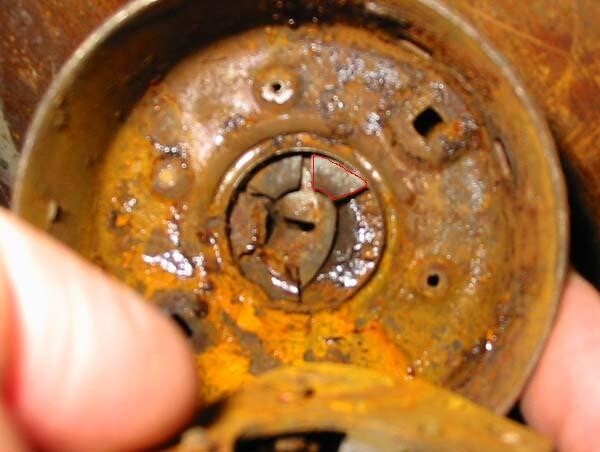
Tom had said:
For whatever reason, there was about 3/8" of play in the shaft. Tom was right – without any play, the bushing can’t go anywhere, and the armature remains centered. But with this play, the armature centers in the stator with energy applied, lifting it (and the bushing!) 3/8 of an inch, allowing the armature to move off center and bind with the stator.
I went to the hardware store, got the right size washers, played with stacking the right amount on the shaft (on the gear end, not the brush end), put power to it and…
it spins like a demon!! Forward, and reverse!!!
Lesson learned, for me. Don’t give up until the fat lady sings. I spent countless hours on this d*mn thing, but I spend about $0.75 in wire and washers and came up with a working motor.
Thanks a bunch to everyone who encouraged and helped along the way.
Dan
TWSAM (The World’s Slowest Auto Mechanic)
Don’t give up until the fat lady sings
Haha! They say that all the time in the movie"Major league 2" I love that!!
Good to hear it works now. When are you putting it back in Faulker? I’ll bet he is happy to have it back 
I attached the motor to the regulator today – when I tightened up the bolts that go through the motor to the assembly, the motor housing clamped to the point where the washers I had stacked on the shaft bound against the housing, and the shaft would not turn freely. I removed a washer, and now there was too much play! the bushing lifted enough to permit the shaft to move off center again, and for the armature to rub against the stator. D*mn!
But it’s a beautiful day in Philly today. I started Faulkner right up, and we cruised to the local Auto Zone, where I picked up some 5/16" washers that were thinner. By substituting thin for thick, I was able to play around to the point where there was no play with the housing clamped down. The motor turns the regulator freely, no binding. Time to put the window back in.
But, what a joy to drive Faulkner! It runs like a dream, despite its 45 years. I turned heads everywhere I went. It’s no creampuff like Tom’s, Roger’s or Ron’s – but it’s mine, and I loved every minute on the road. Does it get any better than this?
Dan
…Part XII.
As TWSAM (The World’s Slowest Auto Mechanic), I finally got the regulator and window back in the driver’s side rear. The motor worked beautifully – until, the star gear worked it’s way out of the rubber connector, despite the tie wrap around it:

Having not fully exhausted my “washer trick”, I pulled the assembly back out, put some lithium grease on the interior flat surfaces of the washers (not quite sure what lithium does to rubber), put a stack on the shaft to prevent the gear from working its way out again, replaced the tie wrap, like so:
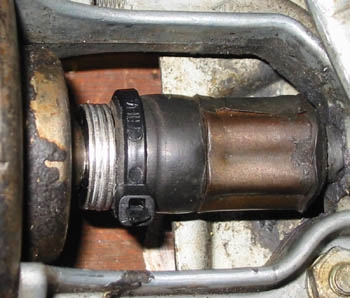
So far, it seems to be holding up. The window goes up and down quite nicely…
Dan